

You love your family. You really do! But somewhere between the family group chat, the family parties, and the nosy questions about your life choices, you start feeling a sense of dread. If you're Filipino American, you know exactly what I'm talking about. The holidays can bring a lot of joy, food, and connection, but they can also bring complicated family dynamics, unspoken expectations, and old patterns.
And here's the thing: You can love your family and still need boundaries. You can appreciate your culture and still want things to be different. Both can be true.
Underlying Cultural Values
In many Filipino families, communication isn't always direct. Sometimes things are implied rather than explicitly stated. Here are some values to keep in mind:
We might rely on pakikiramdam to figure out what's expected of us. Pakikiramdam means being sensitive to the feelings and needs of others. There can also be a strong emphasis on kapwa, a shared identity and interconnectedness. And of course, we cannot forget pakikisama which means maintaining harmony and getting along with others.
These cultural values can make family relationships meaningful, but they can also make it difficult to speak up when something doesn’t feel right. You might want to set a boundary, but the thought of disappointing your parents or creating tension at a family gathering feels worse than just keeping the peace by being silent.
Here's a gentle reminder: You probably aren't going to change decades of family patterns during one holiday event. And that's okay. You don't have to approach every interaction with the goal of confronting, correcting, or educating your family. Sometimes, the goal is simply to navigate the situation in a way that feels aligned with your values. It's not about abandoning cultural values. It's about finding ways to honor your relationships while honoring your needs.
When You're Expected to Attend Every Family Party
You know the drill. There's a Christmas party at Tita Baby’s house, another gathering with your Tito June’s (who is technically a family friend but they’re considered family), and a party at your mom’s co-worker’s house. Yes, we can’t forget about Tita Jeanette’s party. And you're somehow expected to attend all of them! And that’s only on mom’s side of the family.
Maybe you don't mind seeing your family, but spending an entire afternoon or evening socializing can feel draining. Instead of automatically saying yes or completely avoiding the gathering, consider finding a middle ground.
A few ideas:
Bring your own car. Give yourself the flexibility to leave when you're ready instead of relying on someone else's schedule.
Create a side activity. Play board games or video games with your cousins, get boba, or find an Asian restaurant that's open.
Set a time limit. Is 3-4 hours enough time to eat, greet everyone, and play games?
Compromise with your parents. Maybe you'll attend the main family celebration but not Tita Jeanette’s party.
If you need to say no, try the sandwich method: Start with appreciation, communicate your limit, and end with reassurance.
For example:
" I'm glad we're getting together but I won't be able to stay the whole afternoon. I have to do errands and do some work. I'll definitely come by for dinner!"
And if you're not ready to have a lengthy conversation about why you're declining, you can keep your explanation brief. In an ideal world, it should be related to things you’re parents value like school/studies, work, church, or other important family tasks or events. You don't need to submit a five-page report justifying why you can't attend. The goal to practice communicating your limits respectfully, without feeling obligated to overexplain.
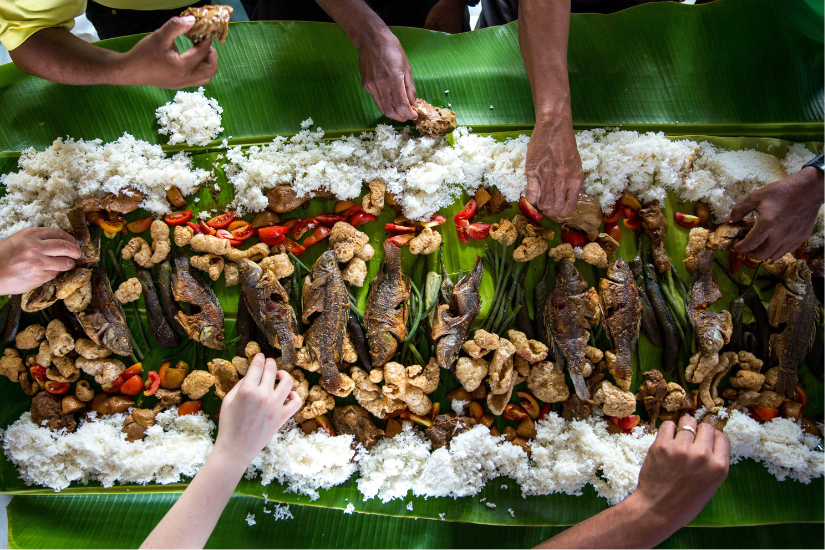
Photo by Avel Chuklanov on Unsplash
When Relatives Ask Personal Questions
"Do you have a girlfriend/boyfriend?"
"When are you getting married?"
"Why are not in nursing like your cousin J.J.?"
"When will you have kids?"
Ah, the holiday interrogation. Sometimes it feels like you're sitting across from a panel of relatives who are evaluating your major life choices. If answering these questions makes you uncomfortable, you have strategies:
· Redirect towards something or someone else: Give a lighthearted response without providing too much information. Then change the topic.
"Still figuring that out! Anyway, did you try Tita Marly’s fruit salad?"
· Redirect back to them: Briefly provide a vague answer. Then shift the conversation towards them.
"Work has been busy, but enough about me. How's your new apo?"
· Distraction: Invite someone into another conversation.
"Tita Baby, I heard you went on vacation to Hawaii recently. How was it? I’ve never been but Tita Lisa has. Tita Lisa, did Tita Baby tell you about her trip to Hawaii?"
· A gentle but firm boundary: Sometimes changing the subject isn't enough.
"I know you're asking because you care, but I'd rather not talk about my dating life today. Let's talk about something else."
Remember, you can be respectful without answering every question. Being family doesn't automatically mean someone is entitled to every detail of your life. These techniques can also work when you do not want to engage in tsismis (gossip).
Getting Caught in the Comparison Trap

Photo by Beth Macdonald on Unsplash
Family parties can bring out comparisons you thought you had outgrown. Maybe your cousin just bought a house, your sibling received a promotion, or someone brings their new girlfriend with them. And suddenly, you're questioning your own accomplishments. Or maybe you're being compared to the version of yourself who existed ten or twenty years ago.
"Your cousin was already an RN in med-surg when she was your age."
"You used to be so much more responsible."
Before you take these comments personally, pause. Sometimes, families fall back into familiar relational patterns because that's what they’re used to. They may still see you as the teenager who needed reminding to clean their room, even though you're now a fully functioning adult with responsibilities of your own. You don't have to accept their version of you.
You can gently point out the pattern:
"I've noticed we tend to compare everyone when we get together. I wonder if we could just celebrate what everyone is doing without comparing?"
Or use a little humor:
"I was like that in middle school, which was a very long time ago!"
And if you're feeling particularly grounded, remind yourself that someone else's accomplishments don't diminish yours. You don't have to turn your life into a competition to prove that you're doing okay.
The Goal is to Learn
The goal isn't to have a picture-perfect Filipino Christmas. It's about learning to show up for your family without constantly sacrificing your own needs. You can honor your culture, love your family, and still have boundaries. Give yourself permission to do things differently and a little grace along the way.
And if family dynamics bring up anxiety, sadness, guilt, resentment, or old wounds, you don't have to navigate them alone. Visit The Collective Clarity to schedule a free 15-minute consultation. I would love to support you in building healthier relationships with yourself and others. Stay tuned for Part 2 of Love the Family but Dread the Holidays where we dive into unresolved family patterns of behavior and communication.
